
Categories
Lakes Region, Local Area Guides, Local Lifestyle, Relocating to New HampshirePublished October 6, 2026
Public and Private Land in New Hampshire: A Guide to Hunting, Fishing, Camping & the Outdoors

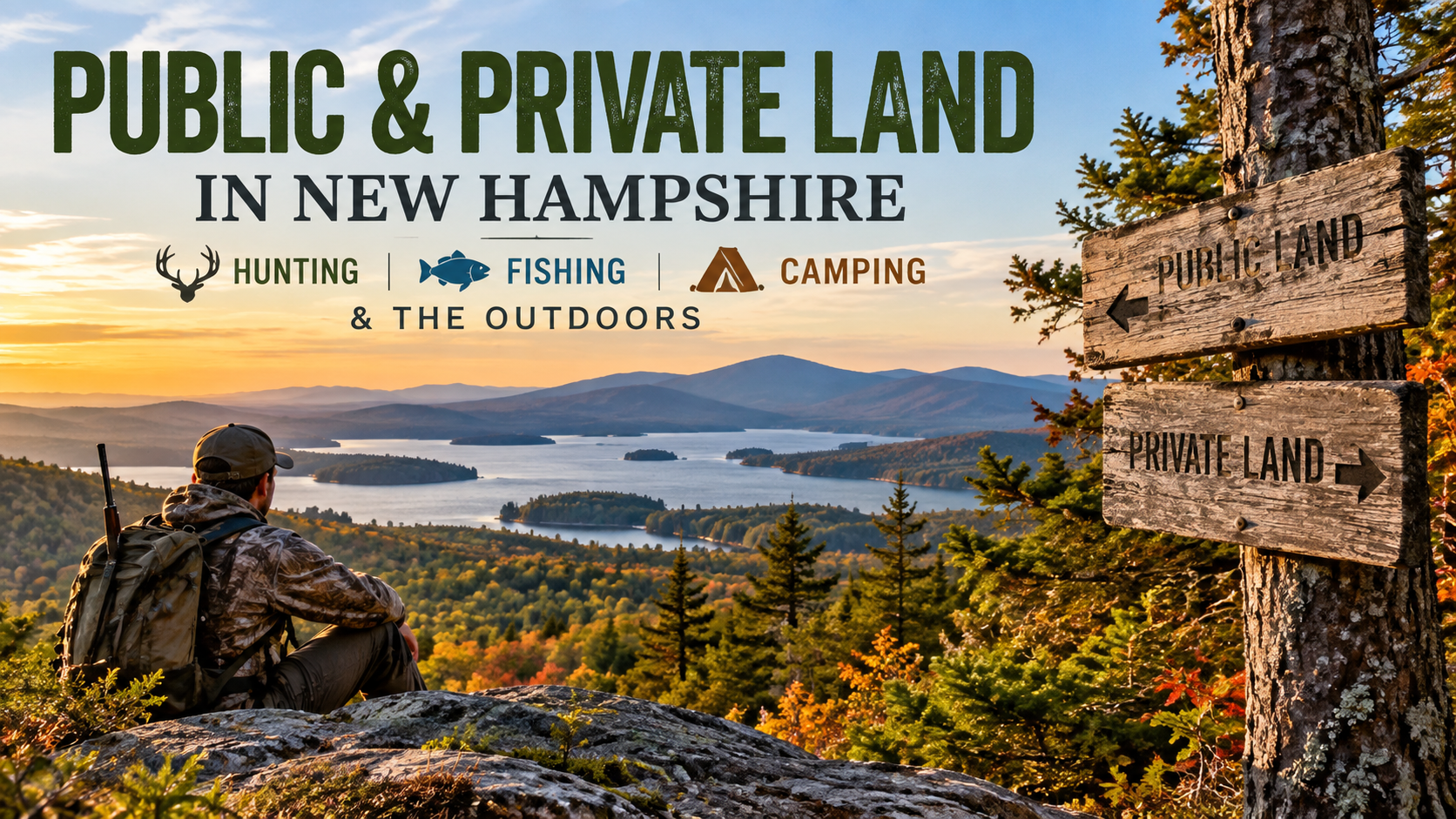
Public and Private Land in New Hampshire: A Guide to Hunting, Fishing, Camping & the Outdoors
One of my favorite things about living in New Hampshire—especially here in the Lakes Region—is just how easy it is to get outside.
We have thousands of acres of public land, state forests, Wildlife Management Areas, conservation land, the White Mountain National Forest, lakes, rivers and trail systems. But something that surprises a lot of people moving here from out of state is how much of New Hampshire's outdoor access also depends on privately owned land.
In fact, more than 70% of New Hampshire's land is privately deeded. Yet generations of landowners have continued a New Hampshire tradition of allowing people to hunt, fish, hike and enjoy the outdoors on their property.
If you're considering moving to New Hampshire because you hunt, fish, hike, camp or simply want more room to explore, understanding the difference between public and private land is important.
Can You Hunt on Private Land in New Hampshire?
Generally, New Hampshire does not require hunters to obtain blanket written permission before entering every piece of private property.
Instead, landowners have the ability to post their property and prohibit activities such as hunting or trespassing. New Hampshire law establishes specific requirements for properly posting land, including signage around the property and at commonly used entrances.
That means you'll commonly encounter several different situations while exploring New Hampshire:
- Private land that is unposted and traditionally open to respectful recreational use
- Land posted "No Trespassing"
- Land specifically posted "No Hunting"
- Property where hunting is allowed by permission only
- Conservation land that allows certain recreational activities but restricts others
- Public land with its own rules and regulations
The most important rule is simple: pay attention to signs and respect the landowner.
Even on land that isn't posted, asking permission when practical is never a bad idea—particularly if you plan to hunt the property regularly. A quick conversation with a landowner can turn access to a piece of property into a relationship that lasts for years.
And if you're granted access, treat the property like you'd want somebody to treat your own.
Don't block gates or driveways. Don't leave trash. Don't damage trails, fields or stone walls. Don't cut trees or build permanent stands without permission. Close gates behind you. Be respectful around homes, livestock and other people using the land.
New Hampshire's open-land tradition only works if outdoorsmen continue giving landowners a reason to keep their property open.
New Hampshire's Public Hunting Land
You certainly don't have to rely on private property to hunt in New Hampshire.
The New Hampshire Fish and Game Department owns and manages a statewide network of Wildlife Management Areas, commonly called WMAs.
Fish and Game has identified 124 WMAs encompassing more than 60,000 acres throughout the state. These lands are primarily managed to protect and improve wildlife habitat, but they're also available for public recreation, including hunting.
Depending on the property, a WMA might include:
- Hardwood ridges
- Wetlands and beaver ponds
- Old fields
- Young forest
- Mature timber
- River corridors
- Deer wintering habitat
- Waterfowl habitat
- Remote backcountry
New Hampshire also has state forests and state park lands. Hunting is permitted in many New Hampshire state parks and forests, although individual properties can have additional restrictions.
Beyond state-owned land, New Hampshire contains federal property including the White Mountain National Forest, along with town forests, conservation properties and other lands protected for public recreation.
The result is a tremendous variety of places to explore.
What About the Lakes Region?
This is one of the reasons I love the Lakes Region.
People naturally think of Lake Winnipesaukee, Lake Winnisquam, Squam Lake and Newfound Lake when they think about recreation here, but the Lakes Region isn't just about being on the water.
Drive away from the shoreline and the landscape changes quickly.
You'll find hardwood ridges, mountains, wetlands, old logging roads, working forests, farms, town forests and large undeveloped tracts scattered throughout communities like Gilford, Meredith, Laconia, Sanbornton, Belmont, Alton, Center Harbor and Moultonborough.
For someone who wants to spend Saturday morning fishing, an afternoon hiking and Sunday sitting in a deer stand, it's a pretty hard lifestyle to beat.
And you don't necessarily need to own 100 acres yourself to enjoy it.
Living near public and accessible private land can give you thousands of acres of recreational opportunity without having to maintain or pay taxes on all of it yourself.
Fishing Access Is a Little Different
Fishing access deserves its own explanation.
New Hampshire has incredible freshwater fishing—from small trout streams and remote ponds to major fisheries like Winnipesaukee and Winnisquam—but being legally allowed to fish a body of water doesn't necessarily mean you can cross somebody's private property to reach it.
That's an important distinction.
Public boat launches, road crossings, public access sites, conservation lands and Fish and Game access areas can provide legal ways to reach the water.
Always determine how you're legally accessing the shoreline rather than assuming that the existence of a lake, river or stream automatically gives you permission to cross the surrounding land.
Once again, respecting access is important. Parking illegally or crossing private property without permission is one of the fastest ways for recreational access to disappear.
What About Camping on Public and Private Land?
Camping rules are also different from hunting and hiking rules.
You shouldn't assume that because you're allowed to walk across or hunt a piece of private property, you're automatically allowed to set up a tent and stay overnight.
Get landowner permission before camping on private property.
For public camping, New Hampshire has plenty of options.
The New Hampshire State Park system operates campgrounds throughout the state, ranging from developed family campgrounds to more primitive sites. State campground stays and reservations are governed by specific park rules.
The White Mountain National Forest also offers developed campgrounds and backcountry or dispersed camping opportunities in certain locations, but restrictions vary by area. Some heavily used areas have designated campsites, Forest Protection Areas or other camping restrictions.
In other words: public land doesn't always mean "camp anywhere."
Check the rules for the specific property before heading in.
Public Land Doesn't Mean Every Activity Is Allowed
This is probably the biggest misconception surrounding public land.
A property being publicly accessible doesn't necessarily mean you can do anything you want there.
One parcel might allow:
- Hunting
- Fishing
- Hiking
- Snowshoeing
- Wildlife watching
…but prohibit ATVs or overnight camping.
Another property might contain trails that cross a combination of public land, conservation easements and private property.
New Hampshire State Parks specifically reminds visitors that some trails originating on state parks and forests continue across private land.
So whether you're hunting, camping, riding, hiking or fishing, look at the regulations for the specific parcel rather than assuming every type of recreation is allowed.
How to Find Places to Hunt and Explore in New Hampshire
If you're new to the state, there are several great places to start.
Look at:
- New Hampshire Fish and Game Wildlife Management Area maps
- New Hampshire State Forest and State Park maps
- White Mountain National Forest maps
- Town-owned conservation land
- Local conservation commission maps
- Public boat launch and fishing access maps
- Conservation easement information
- Current property maps and posted boundaries
Mapping apps can also be incredibly helpful for understanding property lines, terrain and public land boundaries, but don't treat an app as a substitute for signs you encounter on the ground.
Property ownership changes. Maps aren't perfect. Access agreements change.
When in doubt, verify.
Protecting New Hampshire's Outdoor Tradition
One of the things that makes New Hampshire special is that outdoor recreation isn't limited to giant government-owned parks.
It's woven into the landscape.
A trail might cross a state forest before entering private timberland. A hunter might access a piece of unposted land that's been open to local families for generations. A conserved property might sit beside somebody's backyard. A public boat launch might give an angler access to thousands of acres of water.
It works because public agencies, conservation organizations, outdoorsmen and private landowners all play a part.
For hunters in particular, maintaining a good relationship with landowners is critical. New Hampshire Fish and Game operates its Landowner Relations Program specifically to help preserve public access and work with landowners who keep their properties available for recreation.
If we want that tradition to continue, those of us using the land have a responsibility to take care of it.
Living the New Hampshire Outdoor Lifestyle
For me, this is one of the biggest reasons to live here.
You can own a home near Winnipesaukee or Winnisquam, have dinner in town, and still be a few minutes from places where you can hike, fish, hunt, paddle or disappear into the woods for an afternoon.
That's particularly true throughout New Hampshire's Lakes Region, where our lakes get most of the attention but the surrounding woods, mountains and public lands are just as much a part of what makes the area special.
If you're considering moving to the Lakes Region and access to hunting, fishing, hiking, boating or other outdoor recreation is important to you, that's something worth thinking about during your home search—not just the house itself.
Where you live can have a huge impact on how easily you're able to enjoy the things that brought you to New Hampshire in the first place.
Rules, property ownership and recreational access can change. Always check current New Hampshire Fish and Game regulations, property postings, landowner requirements and the rules for a specific public property before hunting, fishing, camping or otherwise accessing land.
Helpful Links
Your Personalized Home Valuation
Popular Searches
Tim Champagne
Realtor with The Dow Group
Keller Williams Coastal and Lakes & Mountains Realty
Cell: 603.520.4955
Office: 603.285.9121
Email: tim@thedowgroup.com
Website: https://tim.thedowgroup.com
Serving Laconia, Tilton, Gilford, Belmont, Franklin, Meredith, Sanbornton, Alton, Wolfeboro, Belknap County, and the greater Lakes Region of New Hampshire.

Adam Dow
| The Dow Group | #1 Real Estate Team in New Hampshire
or another way